
Daily Habits
The Morning Routine as a Personal Standard
A considered look at how structured morning habits shape the rhythm of a man's day — from the first hour of waking to the point of productive engagement.

The city is, in many respects, an adequate fitness facility. Parks, riverbanks, stairwells, the gentle topography of older urban districts — these form a practical landscape for physical development that requires no membership, no booking, and no queue for the squat rack. What it does require is a different kind of thinking: one that treats the urban environment as a training partner rather than an obstacle to movement.
There are men for whom the gym remains the preferred environment — and that preference is entirely valid. The controlled conditions, the range of equipment, the social architecture of a training community: these are genuine advantages that outdoor training cannot replicate. The argument here is not for replacement but for supplementation and, in some cases, for the outdoor setting as the primary environment for men who find the gym friction too high to maintain consistent engagement.
The friction point matters. The most effective training programme is the one that actually gets done. A bodyweight circuit in a nearby park, performed four mornings a week with genuine consistency, will produce better long-term results for most men than a gym membership that yields two visits a week on average. This is not a counsel of mediocrity — it is an observation about the primacy of adherence over protocol.
Beyond adherence, there are specific features of outdoor training that have practical value. Natural light exposure during movement contributes to circadian calibration in ways that indoor fluorescent environments do not. Variable terrain — the small inclines and uneven surfaces of parks and paths — engages stabilising musculature that flat gym floors do not. The absence of mirrors removes a particular kind of self-consciousness that some men find counterproductive to their focus.
Vienna, in this respect, is a generous city. The Prater's long straight avenues and the green corridors of the Donaukanal offer running routes of varying length and character. The outer districts contain parks with outdoor fitness stations — calisthenics bars, parallel bars, climbing frames — that have been installed and maintained to a reasonable standard. The Wienerwald, accessible by public transport from the city centre in under thirty minutes, opens onto trail running terrain with genuine elevation variation.
The practical starting point for most urban men is a walk of the neighbourhood with the specific question: what structures exist here that could support a pull-up, a dip, a incline press, a hanging core exercise? The answer is almost always more than expected. Playground equipment in the early morning hours, stairwells of public buildings, park benches of the right height — these are functional tools. The barrier is not availability but familiarity: the habit of noticing these things as training resources rather than background furniture.
"The most important piece of outdoor fitness equipment is the decision to be outside. Everything else follows from that."
A functional outdoor programme for a man pursuing body composition and general fitness goals might be structured as follows: two sessions per week focused on pushing movements (press-up progressions, dip variations), two sessions on pulling movements (bar-based, ring-based, or suspension), and one session dedicated to lower body and core work using bodyweight and natural terrain. This five-session structure, maintained across a month, provides sufficient stimulus for meaningful adaptation in most men who are not already highly trained.
Progressive overload — the principle that drives adaptation — is achievable with bodyweight training but requires more deliberate management than barbell work, where adding weight is the obvious mechanism. For outdoor training, progression comes through: changes in leverage (elevating the feet for press-ups, reducing the angle of pull for rows), increased range of motion, reduced rest periods, or added volume in the form of additional sets or repetitions. Tracking these variables in a simple log is worth the modest effort it requires.
Running or cycling as a complement to resistance work warrants its own planning. For most men, two sessions of sustained aerobic work per week at an easily conversational intensity is sufficient to maintain cardiovascular health and supports recovery from resistance training rather than competing with it. A third session of higher-intensity interval work — short efforts of 20–30 seconds at genuine exertion, with full recovery between — is a time-efficient way to develop the high-intensity end of aerobic capacity.
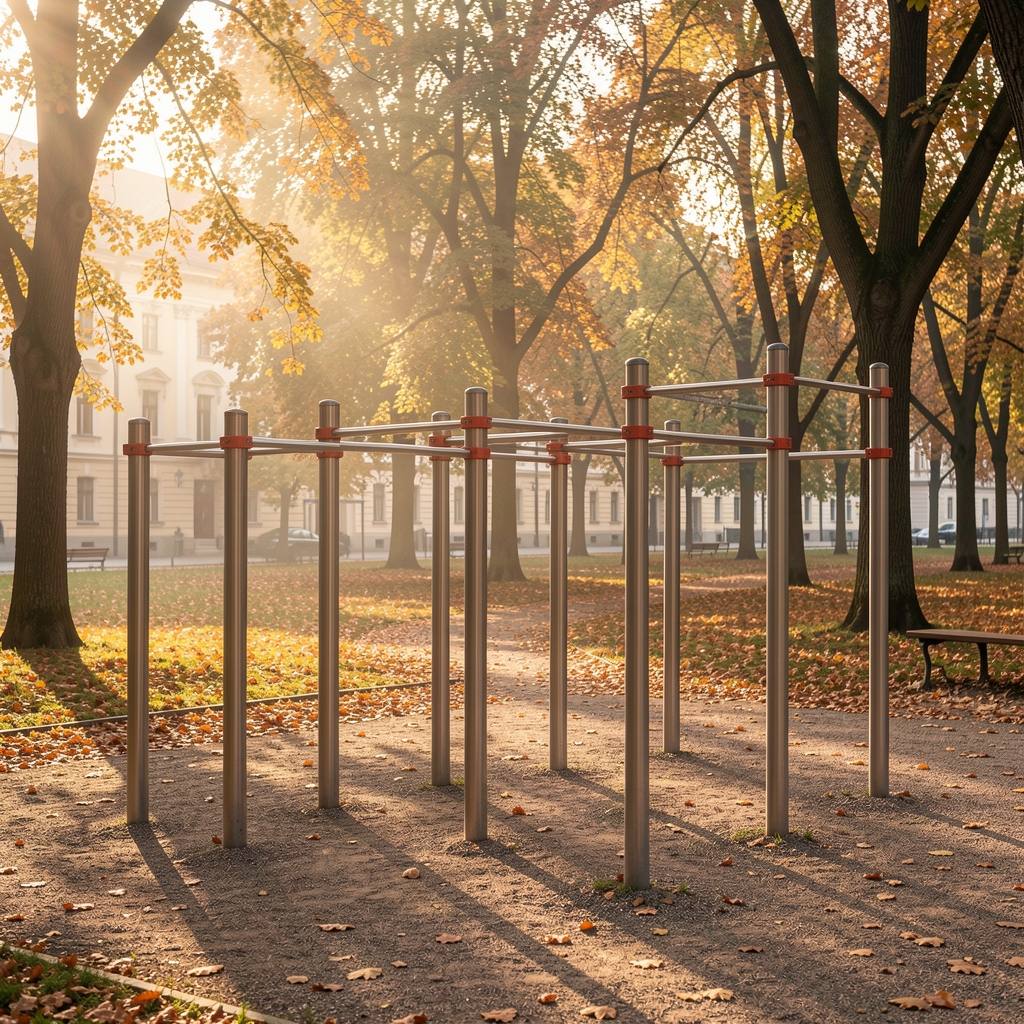
The most common failure mode for outdoor training programmes is the October withdrawal. Temperatures drop, daylight shortens, and the frictionless warmth of a gymnasium — or the sofa — asserts itself. This is not a willpower problem; it is a planning problem. The men who sustain outdoor training through Central European winters do so because they have made specific adjustments rather than attempting to maintain the summer routine unchanged.
The practical adjustments are modest. A base layer and a wind-resistant outer shell make temperatures down to around 2–3°C entirely workable for movement. A headlamp or reflective gear extends usable training hours into the darker mornings and evenings. Reducing session duration while maintaining intensity — 25 minutes of focused work rather than 45 minutes of comfortable volume — keeps the commitment achievable on days when conditions are genuinely uncomfortable. The threshold for going out is lower when the commitment is shorter.
Some men find it useful to approach winter outdoor training as a category of weekend adventure rather than a daily practice — one longer session on Saturday or Sunday that might include a trail run in the Wienerwald or a cycle into a more rural district, combined with two shorter midweek sessions. This seasonal modulation is not failure; it is intelligent adaptation. The goal is a practice that continues across years, not one that is optimal for three months and then abandoned.
The concept of active recovery — movement on days between training sessions that is deliberately gentle — is as relevant to outdoor training as to gym-based work. A 30-minute walk at an easy pace, a slow cycle to work, a short mobility sequence in the morning: these activities support the restorative processes of the body without adding to the training load in a way that accumulates fatigue.
For men who find complete rest days psychologically difficult — those for whom the absence of movement feels uncomfortable rather than recuperative — structured active recovery provides a useful middle ground. The distinction worth maintaining is between movement that restores and movement that accumulates: a gentle walk after a hard strength session is qualitatively different from a second hard session, even if both involve leaving the house.

Tobias Whitfield writes on men's daily habits, active lifestyle, and the quieter disciplines of personal organisation. He has contributed to Marleno Journal since its founding issue.
More from this author →
A considered look at how structured morning habits shape the rhythm of a man's day — from the first hour of waking to the point of productive engagement.

How a Sunday spent in deliberate preparation can change the quality of eating across an entire working week — without the tedium that typically accompanies the advice.